
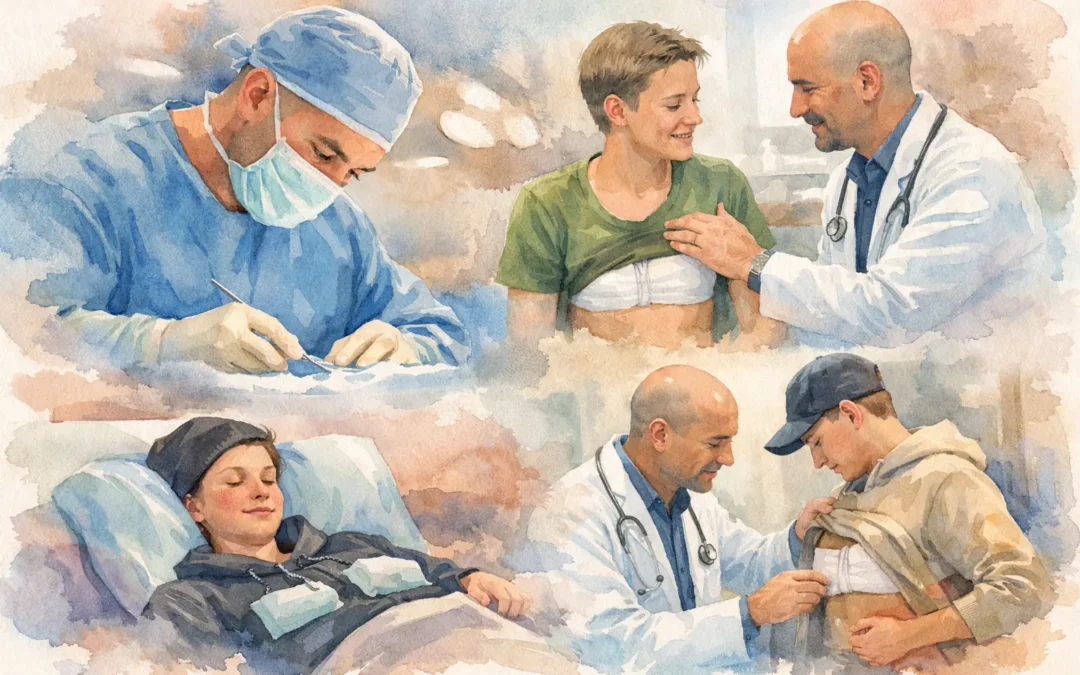
The first few days after surgery tend to feel longer than they are. Patients often want to know one thing right away – when will I feel normal again? The honest answer is that the top surgery recovery timeline is predictable in broad phases, but your exact pace depends on your procedure, your anatomy, how closely you follow instructions, and how your body heals.
A high-quality recovery is not just about getting through the first week. It is about protecting your result, minimizing complications, and giving your chest time to settle into the most masculine contour possible. That is why experienced surgical planning matters before the operation and why disciplined aftercare matters just as much afterward.
Understanding the top surgery recovery timeline
Most patients improve steadily, but recovery is not linear. You may feel noticeably better at one week, sore and tight again after doing too much at two weeks, and then significantly more comfortable by the end of the first month. That pattern is common.
The procedure itself also affects recovery. Double incision top surgery with free nipple grafts usually involves a different healing course than a smaller incision approach. If liposuction is added to refine the chest contour, you may have more swelling or soreness along the sides of the chest and underarm area. Revision surgery can also behave differently because scar tissue changes how tissues respond.
The first 24 to 72 hours
This is the most intensive part of the top surgery recovery timeline. You can expect fatigue, chest tightness, pressure, and limited arm mobility. Pain is often manageable with medication, but many patients describe the sensation as more sore, stiff, or restricted than sharply painful.
Dressings, a compression garment, and often drains are part of early recovery. Drains can feel awkward, but they serve an important purpose by removing fluid that would otherwise build up under the skin. Keeping drain output organized and following instructions carefully reduces unnecessary problems.
During this phase, your job is simple. Rest, hydrate, eat enough protein, walk carefully around the house, and avoid any motion that strains the chest. Reaching overhead, pushing yourself up with your arms, and lifting anything heavy can place stress on fresh incisions and internal healing tissues.
Week 1: swelling, drains, and limited movement
The first week is when patients are most aware of swelling and posture changes. You may stand a little hunched, either from tightness or from trying to protect the surgical area. Bruising is common. Numbness is common too, especially across the chest and near the incisions.
If you have nipple grafts, this week is especially important. Blood supply is reestablishing, and meticulous wound care matters. It is normal for grafts to look strange before they look better. Early color changes and surface crusting can be part of the normal process, which is one reason patients should avoid judging cosmetic results too early.
Many patients are still relying on help with basic tasks during this period. Getting in and out of bed, washing your hair, opening heavy doors, or managing luggage if you traveled for surgery may all be harder than expected. Planning for support ahead of time makes recovery smoother and safer.
Week 2: more comfortable, but not healed
By the second week, a lot of patients feel encouraged because they are moving more easily and discomfort is improving. That improvement can be misleading. You are not healed just because you are more comfortable.
Swelling is still present. The chest may look boxier, fuller, or less defined than expected. One side may heal faster than the other. Small asymmetries in swelling are common early on. This is also a period when patience matters, because overactivity can lead to fluid buildup, prolonged swelling, or widened scars.
Depending on your surgeon’s protocol and your healing progress, drains may be removed around this time if they have not already been removed. Once drains are out, many patients feel a major jump in comfort. Even then, compression and activity restrictions usually continue.
Weeks 3 to 4: returning to daily life carefully
This is often the transition point between early recovery and functional recovery. You may feel well enough to work at a desk, go out more comfortably, and manage normal daily routines with less assistance. That does not mean you should return to full activity.
At this stage, incisions are still gaining strength. Internal tissues are still adhering and settling. Heavy lifting, chest workouts, running, swimming, and intense arm movement can interfere with healing even if you feel capable of doing them.
Appearance also starts to improve, but not evenly. Swelling may collect more along the lower chest or sides. The skin can look wrinkled or firm in spots. The chest may feel hard under the surface because scar tissue is developing internally. None of that automatically means something is wrong.
One to three months: the chest starts to look more like your chest
This is the part of the top surgery recovery timeline when the result becomes more recognizable. Swelling continues to come down, the chest contour sharpens, and most patients begin to feel significantly more mobile and more like themselves.
Scar care often becomes a bigger focus during this period, depending on your surgeon’s instructions. Incisions may look pink, red, or slightly raised before they flatten and fade. That is a normal part of scar maturation. The final scar quality depends on surgical technique, tension on the incision, genetics, skin tone, and aftercare.
Nipple grafts, if used, also continue to evolve. Pigment changes, texture changes, and gradual improvement in appearance can continue for months. Sensation may begin to return in certain areas, but it may be patchy or incomplete. Some numbness can last a long time, and some changes in sensation may be permanent.
This is also when patients often ask if their result is final. Usually, not yet. You may be seeing a strong early result, but subtle swelling can persist longer than most people expect.
Three to six months: scars mature, swelling continues to resolve
By this stage, most patients are back to a much broader range of normal activity, assuming healing has gone smoothly and they have been cleared by their surgeon. Exercise is often better tolerated, chest tightness is reduced, and the result looks more natural in and out of clothing.
Still, this period is about refinement, not instant perfection. Scar color may still be prominent. Areas of firmness may soften gradually. If there is residual swelling, especially near the outer chest, it often becomes less noticeable over time.
This is also a key period for perspective. Patients sometimes fixate on small irregularities that are still changing. Experienced surgeons know that early contour concerns often improve simply because healing is still underway. On the other hand, persistent issues should be followed properly rather than ignored. Good follow-up care matters because knowing what is normal and what deserves attention is part of expert postoperative management.
Six months to one year: settling into the final result
The final phase of the top surgery recovery timeline is slower and more subtle. Scars continue maturing, chest tissues soften, and the overall contour settles. For many patients, the chest at one year looks and feels meaningfully better than it did at three months.
This is usually the most appropriate window for evaluating long-term cosmetic details. If revision is needed, it is generally better assessed after tissues have had time to mature, although the exact timing depends on the issue being addressed. Patients who had prior surgery elsewhere and are pursuing revision often understand this well – tissue quality and scar behavior do not reveal their full story in the early months.
What can slow recovery down
Healing is not just about time on a calendar. Smoking or nicotine exposure, poor nutrition, aggressive activity too soon, inconsistent compression use, and failure to follow wound care instructions can all delay progress. Travel can also make the first phase more demanding, which is why planning matters for out-of-town and international patients.
Your own baseline health plays a role too. Some people swell more. Some scar more aggressively. Some regain energy quickly, while others need more time. The safest mindset is not to compare your recovery too closely to photos or anecdotes from other patients.
When to contact your surgeon
Some concerns are expected. Others need prompt attention. Rapid swelling on one side, increasing redness, fever, worsening pain, foul drainage, or anything that looks suddenly different rather than gradually improving should be reported. A calm, well-supported recovery depends on communication, not guesswork.
That is one reason specialized practices such as The Garramone Center place so much emphasis on patient education and structured follow-up. Top surgery is not a generic operation, and recovery guidance should not be generic either.
A better way to think about recovery
The most useful way to approach recovery is this: the first two weeks are about protection, the first six weeks are about restraint, and the first year is about refinement. If you expect instant final results, you will likely feel frustrated. If you understand that healing happens in stages, you are far more likely to recognize progress when it is happening.
The goal is not just to get through recovery fast. The goal is to heal well enough that your result holds up over time, looks natural, and supports the life you want to live once your chest no longer feels like something you have to manage every day.