
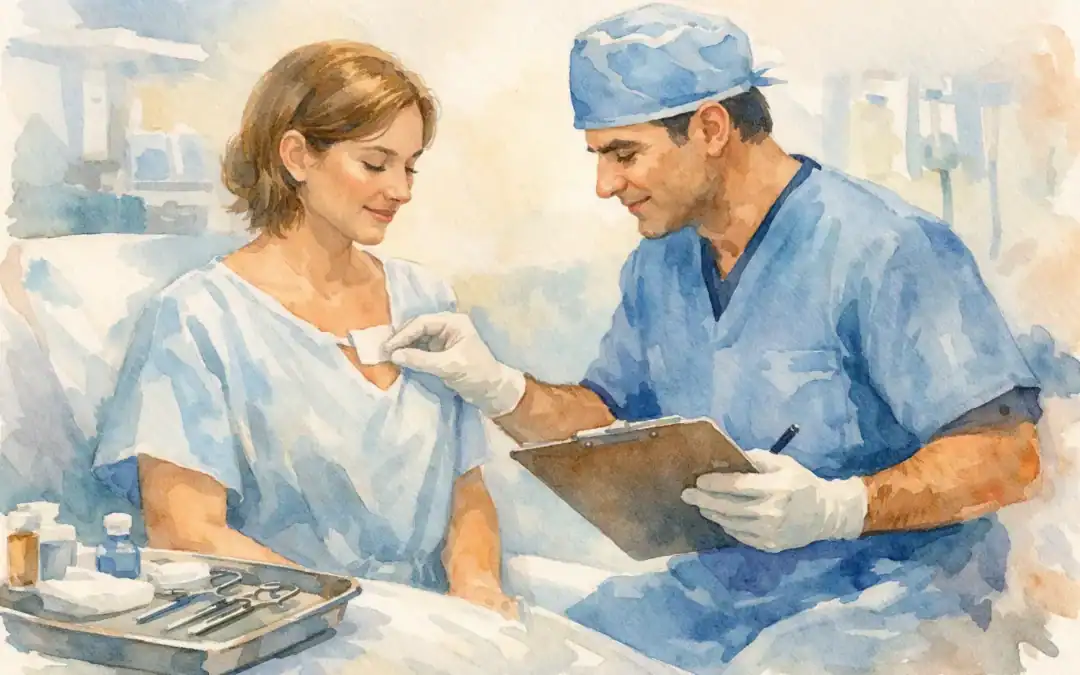
The first time you remove the dressings and look at your chest, the nipples are often the detail that causes the most anxiety. Patients expect the incision lines to look surgical. What catches them off guard is how unpredictable nipple graft healing after surgery can appear in the early weeks. Color changes, scabbing, swelling, and uneven progress are all common, and none of them tell the full story too early.
In masculinizing chest surgery, free nipple grafts are a highly refined part of the procedure, but they still heal on their own biological timetable. That matters because grafts are not healing like a standard skin incision. They must establish blood supply in their new position, stabilize, and mature over time. A graft that looks concerning at one stage may go on to heal well, while a graft that looks good early still needs careful aftercare to protect the final result.
How nipple graft healing after surgery actually works
A nipple graft is tissue that has been removed and then placed back onto the chest in a new location. Unlike nearby skin that remains attached to its original blood supply, the graft has to revascularize. In plain terms, it needs to connect to the blood supply in the chest wall again.
This is why the earliest phase of healing can look dramatic. Right after surgery, the graft may appear pale, dark, bruised, flat, or even slightly shriveled. That does not automatically mean something is wrong. Early appearance is often a poor predictor of the final outcome because circulation is still developing and the superficial layers can go through temporary changes before healthier tissue declares itself.
For top surgery patients, especially those having double incision chest masculinization with free nipple grafts, this process is expected. The key is understanding the normal sequence and following post-op instructions with precision. In a specialized practice that performs a high volume of masculinizing chest procedures, patient education around graft care is not a small detail. It is part of protecting the result.
What is normal in the first few weeks
During the first week, grafts are usually covered with bolsters or dressings that help keep them immobilized against the chest. That contact matters. Grafts take best when they are secure and protected from shear, friction, and unnecessary movement.
Once those dressings come off, many patients are surprised by how rough the nipples can look. They may seem darker than expected, develop a crusted or scabbed surface, and look uneven from one side to the other. Mild drainage can happen. A pink rim around the graft may also be seen as healing progresses.
By weeks two to four, the outer layer often dries and sheds. This can make the nipples look worse before they look better. Some areas may appear patchy in color. One nipple may heal faster than the other. That is common. Human healing is rarely symmetrical in real time, even when surgery is highly precise.
Swelling in the surrounding chest can also affect how the grafts look. As swelling settles and the skin relaxes, nipple shape and projection may continue to change. Patients who judge the result too early often create unnecessary stress for themselves.
The nipple graft healing timeline
A realistic nipple graft healing timeline helps patients stay grounded. In the first one to two weeks, protection is the priority. The graft is delicate, and blood supply is still re-establishing. This is the phase where dressings, compression, and activity restrictions matter most.
From two to six weeks, surface healing becomes more visible. Scabs may lift. Pinkness can increase before fading. The nipples may look flat or slightly irregular. Sensation is often limited or absent at this point.
From six weeks to several months, the grafts usually continue to settle in color and texture. Pigment can return gradually, although some patients experience partial lightening or color mismatch. Final scar maturation and contour changes continue long after the surface appears healed.
By six months to a year, the nipples typically look more stable. Even then, minor changes can still occur. This is one reason experienced surgeons counsel patience. Final judgment too early is one of the most common mistakes in recovery.
What can affect nipple graft healing after surgery
Healing is influenced by more than technique alone. Surgical experience is critical, but patient factors and post-op behavior also matter.
Blood flow is the central issue. Anything that compromises circulation can interfere with healing. Nicotine use is one of the most serious examples. Smoking, vaping, nicotine gum, and nicotine patches can all reduce blood supply and increase the risk of graft loss or delayed healing. For patients pursuing chest masculinization surgery, nicotine restrictions are not arbitrary. They are a direct safety issue.
Tension, pressure, and friction also matter. If a patient returns to activity too aggressively, sleeps in positions that irritate the chest, or fails to protect the grafts during the vulnerable phase, healing can suffer. The same is true for picking at scabs. Patients often do this because they are worried about how the graft looks. Unfortunately, that can interrupt healing at exactly the wrong time.
General health plays a role as well. Nutrition, hydration, underlying medical conditions, and the body’s natural healing response all contribute. Some patients simply heal faster than others. That does not mean the slower patient has a worse outcome ahead.
Signs of normal healing versus warning signs
Normal healing includes scabbing, darkening, temporary discoloration, mild asymmetry, and a gradual change in surface texture. It can also include the graft looking flat or dry before it improves. These features are common enough that they should not trigger panic by themselves.
Warning signs are different. Worsening redness that spreads into the surrounding skin, foul odor, thick pus-like drainage, increasing pain after the early post-op period, fever, or a graft that appears to be separating significantly from the chest should prompt direct contact with your surgical team. Persistent dusky discoloration can also need evaluation, especially if paired with other concerning symptoms.
This is where specialized follow-up matters. Patients do best when they are not guessing. They need clear instructions, expected milestones, and access to a team that knows the difference between normal graft evolution and a true complication.
How to support the best possible result
The best aftercare is disciplined aftercare. Follow dressing instructions exactly. Keep the area clean and dry as directed. Avoid chest strain until cleared. Do not start scar products, ointments, or home remedies unless your surgeon has specifically approved them for that stage of healing.
Patients often want to know if there is a single product that improves graft survival. Usually, the more important factor is not a miracle topical. It is whether the graft was placed well, protected properly, and allowed to heal without interference. Excellent outcomes come from a combination of surgical expertise and patient compliance.
It is also important to manage expectations around sensation and pigment. Some return of sensation may occur over time, but it varies. Pigment may come back evenly, partially, or not completely. Projection may remain more subtle than it was before surgery. These are not necessarily failures. They are known trade-offs of free nipple graft techniques and should be part of an honest pre-op discussion.
Patience is part of the process
For many patients, the emotional side of healing is harder than the physical side. Chest masculinization surgery can be life-changing, but recovery still includes vulnerable moments. Looking at healing grafts every day can make normal fluctuations feel bigger than they are.
That is why experience matters so much in this field. A surgeon who has performed a very high volume of masculinizing chest procedures has seen the full range of normal healing and knows when reassurance is appropriate and when intervention is needed. At a specialized center like The Garramone Center, that depth of focus is part of what gives patients confidence through the recovery process.
If your nipple grafts look imperfect early on, that alone is not the story. Healing unfolds in stages, and grafts often earn their final result slowly. Give them time, protect them carefully, and stay in close communication with your surgical team when something feels off.